
Patients who ask about custom orthotics have usually already tried the store-bought version. They picked up a pair of Dr. Scholl’s or a similar prefabricated insole, wore them for a few weeks, and got either no improvement or only partial relief. The question they’re actually asking when they come in is whether custom orthotics are worth the difference in cost — and the honest answer is that it depends on what’s driving their symptoms. Custom orthotics are not always necessary. But when they are, no OTC insole is a functional substitute.
What Store-Bought Insoles Actually Do
Prefabricated insoles provide cushioning and modest arch support in a standardized shape designed to fit the statistical average foot. They are built to a size range, not to an individual. For patients with mild symptoms related to inadequate cushioning — someone who stands on hard floors all day in unsupportive shoes, for example — an OTC insole may provide meaningful relief. They are inexpensive, immediately available, and appropriate for that narrow use case.
What they cannot do is correct biomechanical dysfunction specific to your foot structure. A prefabricated insole does not know whether you overpronate, supinate, have a leg length discrepancy, a forefoot varus, or a structural deformity affecting load distribution. It provides the same support regardless of what your foot actually does when you walk, run, or stand. For patients whose pain has a biomechanical origin, this is the fundamental limitation.
What Custom Orthotics Actually Do
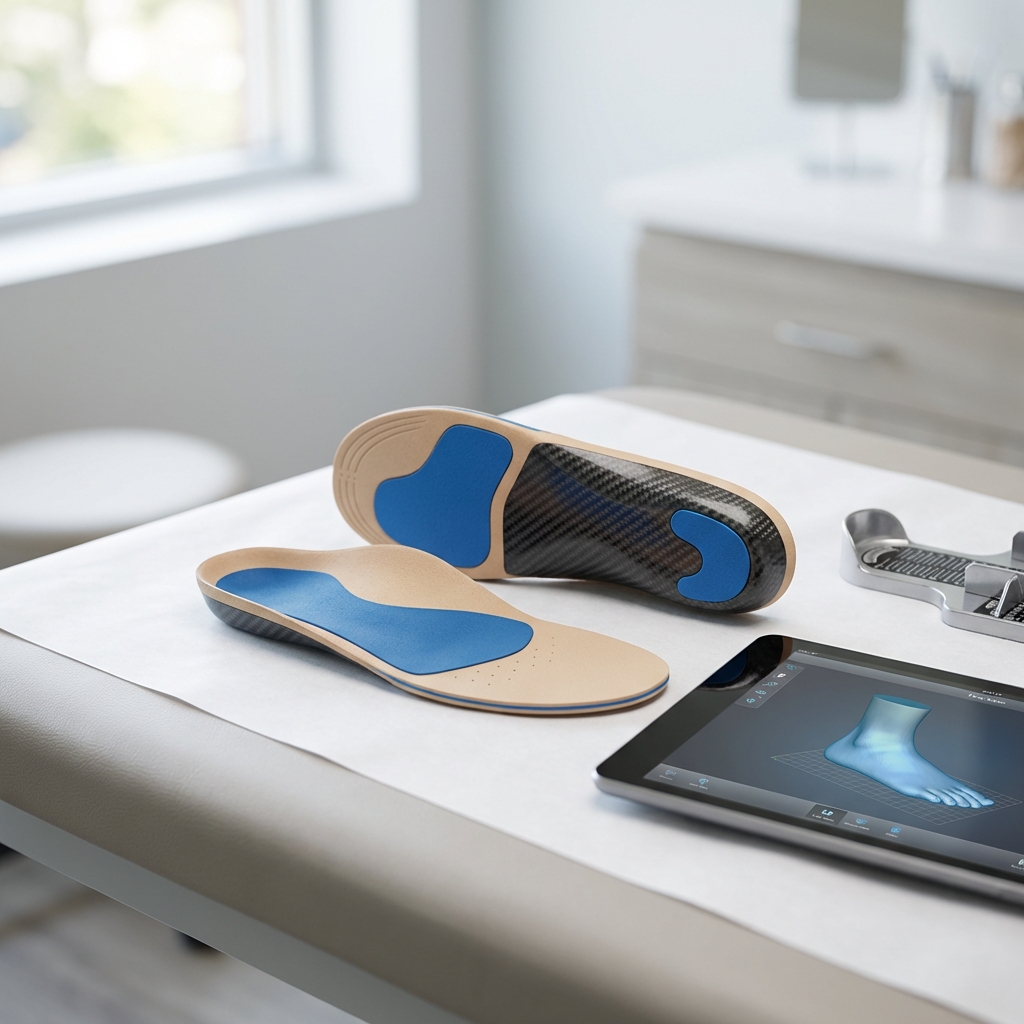
A custom orthotic is a prescription medical device fabricated from a three-dimensional model of your foot, captured while your foot and ankle are held in a clinically neutral position. The device is designed around your specific foot structure, gait pattern, and the mechanical problem being addressed. It is not a cushioned insole in a different package — it is a functional device with a specific therapeutic purpose.
Custom orthotics work by controlling the position and motion of the foot through the gait cycle. Depending on what the evaluation finds, the device may limit excessive pronation, redistribute plantar pressure away from a painful structure, accommodate a bony prominence, or correct for a leg length discrepancy. The prescription — including shell rigidity, posting, accommodations, and top cover material — is determined by the clinician based on your examination findings, not selected from a menu of standard options.
The Difference in Fabrication
| Factor | Store-Bought Insoles | Custom Orthotics |
|---|---|---|
| Fit | Standardized size range | Fabricated from 3D cast of your foot |
| Design basis | Generic arch height and cushioning | Prescription based on clinical evaluation and gait analysis |
| Function | Cushioning, modest support | Biomechanical control and correction |
| Shell material | Foam or soft plastic | Rigid, semi-rigid, or flexible depending on prescription |
| Modifications | None | Posted, accommodated, padded per clinical need |
| Durability | 3–6 months typical | 2–5 years with normal use |
| Cost | $15–$60 | $300–$600 typical; often partially covered by insurance |
Who Actually Needs Custom Orthotics
Not every patient with foot pain needs custom orthotics, and I won’t recommend them when they aren’t clinically indicated. The patients who benefit most share a common thread: their pain has a mechanical origin that a standardized insole cannot address. That typically includes:
- Plantar fasciitis with a biomechanical component: Overpronation and forefoot instability are common drivers of plantar fascia overload. When these are present, an orthotic that controls pronation and offloads the fascia is part of the treatment — not an add-on. Patients managing a long recovery from plantar fasciitis who haven’t addressed the mechanical component are working against themselves, as we’ve covered in our post on how long plantar fasciitis takes to heal.
- Structural deformities: Bunions, hammertoes, and flatfoot deformity alter load distribution in ways that prefabricated insoles cannot correct
- Leg length discrepancy: Even a small functional or structural leg length difference can produce pain throughout the lower extremity — foot, ankle, knee, hip — and a heel lift or posted orthotic is often the most effective intervention
- Runners and high-activity patients: Athletes who log significant mileage put their foot mechanics under repeated stress. Small biomechanical inefficiencies that are asymptomatic at low activity levels become injury drivers at volume
- Diabetic foot offloading: Patients with peripheral neuropathy require pressure redistribution to prevent ulceration — accommodative orthotics for this population are a clinical necessity, not a comfort upgrade
Who Probably Doesn’t
A patient with mild, intermittent heel discomfort related to spending a long day in unsupportive shoes — and no structural or biomechanical findings on examination — may do fine with a quality OTC insole and a footwear change. Someone whose symptoms resolve completely with conservative care and appropriate shoes doesn’t need a custom device. Part of a thorough evaluation is ruling out the cases where the simpler solution is genuinely sufficient.
The evaluation visit at Momentum is the right place to get that answer. If you don’t need custom orthotics, I’ll tell you that. If you do, I’ll explain exactly why based on what the examination shows — not a general recommendation that everyone benefits from better arch support.
Insurance and Coverage
Custom orthotics are covered by many insurance plans when there is a documented medical indication — plantar fasciitis, diabetic foot care, structural deformity, and similar diagnoses typically qualify. Coverage varies significantly by plan, and some plans exclude orthotics entirely. Our office will verify your benefits before fabrication so you know what to expect on cost. For patients with Medicare, coverage depends on diagnosis and documentation requirements that we handle as part of the ordering process.
The Evaluation Process at Momentum
A custom orthotic prescription starts with a clinical examination that includes gait analysis, assessment of foot and ankle range of motion, evaluation of structural alignment, and a review of your symptoms and activity demands. If orthotics are indicated, a non-weightbearing cast or digital scan of your foot is taken in subtalar neutral position — this is the model the orthotic lab fabricates from. The finished device is typically delivered within 2–3 weeks, with a fitting visit to confirm fit and make any necessary adjustments.
If you’ve been managing foot or heel pain with OTC insoles that aren’t working, the question worth answering is whether your problem has a mechanical origin that requires a mechanical solution. That’s a clinical determination — not something a product description or online quiz can tell you.
Want to know if custom orthotics are right for your situation?
✔ Schedule an evaluation at Momentum Foot & Ankle in Omaha
✔ We’ll tell you honestly whether custom orthotics are indicated — and why
✔ Call us or book an appointment online


Call Us Today: 402.315.4406