
Achilles tendinopathy is one of the most stubborn overuse injuries in podiatric practice. Patients follow the standard protocol — rest, stretching, physical therapy — and still find themselves months later with the same pain, the same morning stiffness, and the same limitation in activity. If that describes where you are, radial shockwave therapy (RSWT) is worth understanding before you consider more invasive options.
What Is Achilles Tendinopathy?
Achilles tendinopathy is a degenerative condition of the Achilles tendon, typically occurring either at the insertion point on the heel bone (insertional tendinopathy) or a few centimeters above it (mid-portion tendinopathy). Despite what patients are often told, chronic tendinopathy is not primarily an inflammatory condition — it is a failed healing response. The tendon tissue has undergone structural breakdown, with disorganized collagen, micro-tears, and abnormal blood vessel ingrowth, and it is not recovering on its own.
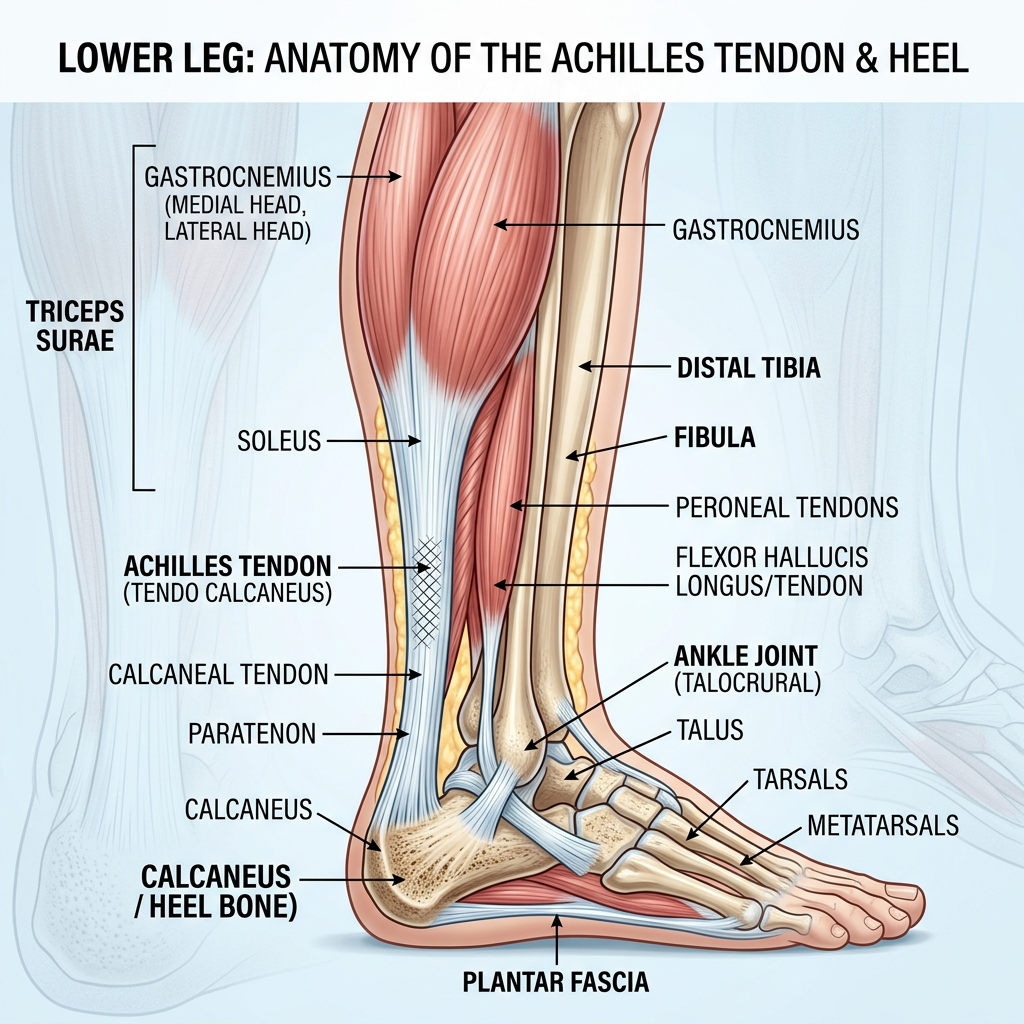
This distinction matters clinically because treatments that target inflammation — including anti-inflammatory medications and prolonged rest — address a process that isn’t actually driving the chronic condition. They can reduce pain in the short term, but they don’t repair the underlying tissue. That’s why so many patients plateau with conservative care.
How Radial Shockwave Therapy Targets Tendon Degeneration
RSWT delivers acoustic pressure waves directly to the affected tendon tissue. Unlike anti-inflammatory approaches, shockwave therapy works by initiating a controlled biological repair response. The acoustic waves stimulate neovascularization — the formation of new, healthy blood vessels — and trigger collagen synthesis and remodeling in the degenerated tissue. In a tendon that has been stuck in a failed healing cycle, RSWT essentially restarts the repair process.
Treatment is delivered in 3–5 sessions spaced one week apart. Each session takes approximately 10–15 minutes. There are no needles, no downtime, and no systemic effects. Patients typically experience temporary soreness at the treatment site for 24–48 hours following each session, which is an expected part of the healing response.
What the Evidence Shows
RSWT for Achilles tendinopathy has a substantial clinical evidence base. Multiple randomized controlled trials and systematic reviews have examined its efficacy, particularly for mid-portion tendinopathy. The consistent finding is that shockwave therapy produces meaningful reductions in pain and improvements in function, with results that are durable at 12-month follow-up. Comparative studies have shown RSWT to be superior to eccentric exercise alone and at least equivalent to surgical options in appropriately selected patients, without the recovery burden of an operation.
Insertional Achilles tendinopathy responds somewhat differently than mid-portion involvement. The evidence for RSWT at the insertion is still supportive, but the treatment parameters and expected timeline differ. A thorough clinical evaluation — including imaging — is necessary to determine which variant you’re dealing with and whether shockwave is the appropriate next step.
Who Is a Good Candidate for RSWT?
RSWT for Achilles tendinopathy is most appropriate for patients who meet the following criteria:
- Chronic symptoms of 3 months or more that have not resolved with conservative care including rest, stretching, and physical therapy
- Imaging-confirmed tendinopathy — ultrasound or MRI showing degenerative changes without complete tear
- No active infection at or near the treatment site
- Not currently taking anticoagulant medications or with blood clotting disorders
- Not pregnant
Patients who have already had cortisone injections without lasting benefit are frequently good candidates. As we’ve discussed in our post on shockwave therapy vs. cortisone injections, these two treatments work through entirely different mechanisms — a failed cortisone trial does not predict a failed shockwave outcome.
What to Expect from Treatment
RSWT does not produce immediate relief. This is one of the most important things to understand before starting treatment. The biological repair process the therapy initiates takes time to produce clinical results. Most patients begin to notice meaningful improvement between weeks 4 and 8 after completing their treatment sessions, with continued improvement through 3–6 months.
This timeline is different from cortisone, which can reduce pain within days. But the mechanism is also different: cortisone suppresses symptoms over damaged tissue; RSWT repairs the tissue. For patients who have been struggling with Achilles pain for six months or more, the question isn’t which treatment works faster — it’s which treatment produces results that last.
During the treatment period, complete rest is not required or recommended. Light to moderate activity is generally maintained. Your podiatrist will give you specific guidance based on your symptom severity and imaging findings.
When Shockwave Is Not the Answer
RSWT is not appropriate for every Achilles presentation. A complete or significant partial tear of the Achilles tendon requires a different treatment approach — shockwave therapy is contraindicated in the presence of a tendon rupture. It is also not a substitute for surgical evaluation in cases where structural failure is present or when conservative and shockwave treatment have both failed.
The goal at Momentum is to match you with the right intervention for your specific pathology. That sometimes means shockwave therapy. It sometimes means a different approach. It always means an honest clinical evaluation before any recommendation is made. If you’ve been reading about shockwave and wondering whether it applies to your situation, the right next step is a consultation — not more internet research. Similar principles apply to plantar fasciitis, where the same pattern of failed conservative care and appropriate escalation to RSWT plays out regularly.
Not sure if shockwave therapy is right for your Achilles pain?
✔ Schedule a consultation at Momentum Foot & Ankle in Omaha
✔ We’ll review your imaging, history, and treatment timeline
✔ Call us or book an appointment online


Call Us Today: 402.315.4406